
Meet Ruth Ro, Dattner Architects

On April 30, the 2025 Open City Benefit will bring together hundreds of New Yorkers for a festive evening at the Brooklyn Navy Yard in BLDG 303.
Ruth Ro, Partner at Dattner Architects, the architect of BLDG 303, will accept the 2025 Builder Award on behalf of the BLDG 303 design-build team.
About Ruth
Ruth Ro’s interest in real estate politics and her background as both an economic development analyst and painter have shaped her understanding of consensus-building and its importance within urban architecture. Whether through her art exhibit, “Icons of the Meatpacking District,” a collection of portraits that presented key players in the neighborhood’s transformation, or through managing large-scale mixed-use projects, Ruth is naturally adept at bringing people together and facilitating dialogue. Her approach to working with clients and consultants is characterized by a commitment to problem solving and the ability to aid communication between participants, successfully integrating multiple perspectives.
Ruth holds a Master of Architecture from Columbia University and a Bachelor of Arts in philosophy from New York University.
You’ve been working at Dattner Architects since 2012. What most excites you about your work with the firm?
I joined Dattner Architects in 2012 because I was drawn to the firm’s deep commitment to civic architecture and a clear alignment in values—particularly the belief that design can be a force for public good. Over the years, it’s been exciting to see our work evolve to include larger, neighborhood-scale mixed-use developments that are actively transforming communities. Much of this work has come from close collaboration with the City to bring attention and investment to areas that have long been overlooked. It’s incredibly rewarding to be part of a team that’s helping to shape places in a way that brings new life, opportunity, and resilience to neighborhoods across the city.
How did you first enter the workforce? What made you want to become an architect?
I came into the architecture profession in a roundabout way. Although I studied architecture, I initially chose to work on the City side, joining a nonprofit economic development organization (Lower Manhattan Development Corporation). I was interested in understanding the broader ecosystem of stakeholders who shape development at the city scale—how decisions are made, who’s at the table, and how communities are impacted. After that, I spent time as an artist, painting portraits of people who shape neighborhoods, which deepened my connection to the human stories behind urban change. It wasn’t until I discovered architecture firms that operate at this larger scale—engaging with systems, policy, and community—that I found my way back to the profession. I think this passion comes from growing up in both urban and suburban underserved areas and experiencing firsthand the effects of disinvestment and poor planning. It’s what drives me to work on projects that are thoughtful, inclusive, and transformative.
"It’s incredibly rewarding to be part of a team that’s helping to shape places in a way that brings new life, opportunity, and resilience to neighborhoods across the city."
- Ruth Ro, Partner, Dattner Architects
What can you tell us about the design and development of BLDG 303?
Building 303 is a significant project—not only because of its design, but because it's the first ground-up development by the Brooklyn Navy Yard Development Corporation. BNYDC’s mission is to reignite and sustain high-quality manufacturing jobs for New Yorkers, and Building 303 was designed to support that mission. It’s a light industrial building tailored for tenants in manufacturing, tech, and the creative industries with flexible spaces that can accommodate a range of uses. The expansive floor plates support heavy equipment and opportunity for a variety configurations. The infrastructure, like mechanical rooms, shafts, and roof capacity, is designed for future upgrades.
From the massing and the floor-to-floor heights to the structural system and material choices, every element was intentionally designed to reflect and support modern manufacturing. While we considered brick as an homage to the Navy Yard, we ultimately chose precast concrete—fabricated off-site and erected on-site—as the primary system. It serves as structure, façade, insulation, and weatherproofing all in one. That choice speaks to the ethos of modern industry: efficient, forward-thinking, and performance-driven. It’s not just about how the building looks—it’s about how it came together and how it works for the people inside. And while industrial buildings in the past have disregarded the occupant, Building 303 provides gracious windows and views as well as impressive glazed staircases to encourage activity and promote physical health.
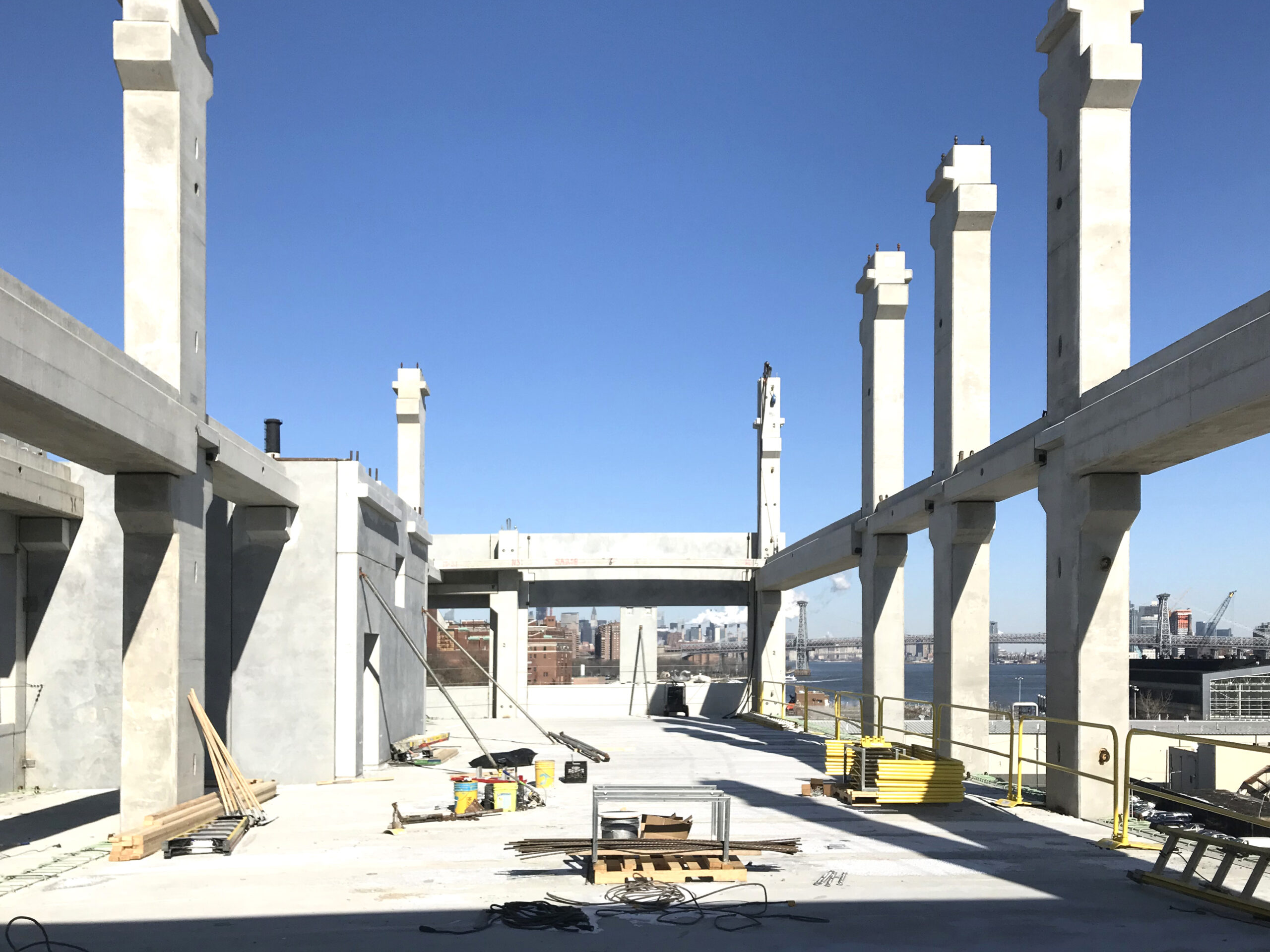
"BNYDC’s mission is to reignite and sustain high-quality manufacturing jobs for New Yorkers, and Building 303 was designed to support that mission."
- Ruth Ro, Partner, Dattner Architects
Besides BLDG 303, what is your favorite New York City waterfront spot?
Chelsea Piers. In any other city, the waterfront is often the most developed area—lined with high-end retail, luxury apartments, and Class A office space. New York is slowly catching up after many decades of untapped potential. I spent a lot of time at Chelsea Piers when my kids were younger, and what I love most is its almost makeshift, improvised character. The way the structures are organized along the water feels organic and unplanned—you meander through parking garages, covered arcades, and then suddenly find yourself in the open air, surrounded by docks lined with yachts and sailboats. There are hidden nooks and crannies everywhere. It’s chaotic in the best way, and it captures a kind of authentic New York energy that’s increasingly rare.
You've led several tours for Open House New York (thank you!), and Dattner Architects has been an OHNY Weekend partner since our earliest days. Why are you an Open House New Yorker? What does it mean to "open up" the city?
I’m an Open House New Yorker because I love the people who join the tours. Our attendees are so excited to get a sneak peek into places they don’t normally have access to—and more than that, they are even more eager to hear the stories behind those spaces. And sure, I love talking about buildings and walking people through the design process like a narrative. Realizing a building takes years, and there are a lot of stories to tell. But what really brings me joy is seeing how much joy folks get from hearing them. You realize how often we, as designers, take for granted that people do care, do appreciate, and do want to learn about how buildings are realized. Open House New York is literally and figuratively opening up the city—making architecture more accessible and the process more transparent. You don’t need to sit through three hours of The Brutalist to get insight into the inner workings and hear a good story. That’s fiction. With OHNY, you get real stories from real architects.
"Open House New York is literally and figuratively opening up the city—making architecture more accessible and the process more transparent."
- Ruth Ro, Partner, Dattner Architects